
Most of my peers agree: B2B Marketing is broken. While we have more technology, more data, more processes and more insights than ever before, we are always defending our decisions, and endlessly proving the value of marketing. The root of the issue lies in a lack of understanding of the complex nature of marketing. Marketing involves solving a multi-dimensional equation to guide prospects from unawareness to consideration and purchase, a journey that is complex, non-linear, and of varying durations. Yet, stakeholders often seek results based on simplified, discrete metrics like “Just get me a 5x pipeline!”
The second problem is related to the first one, because those that assess and determine Marketing’s contribution (i.e., the CEO, board and investors) don’t understand or appreciate the function’s complexity and tangible value marketing contributes to propel company growth throughout the buyer’s journey and customer’s lifespan.
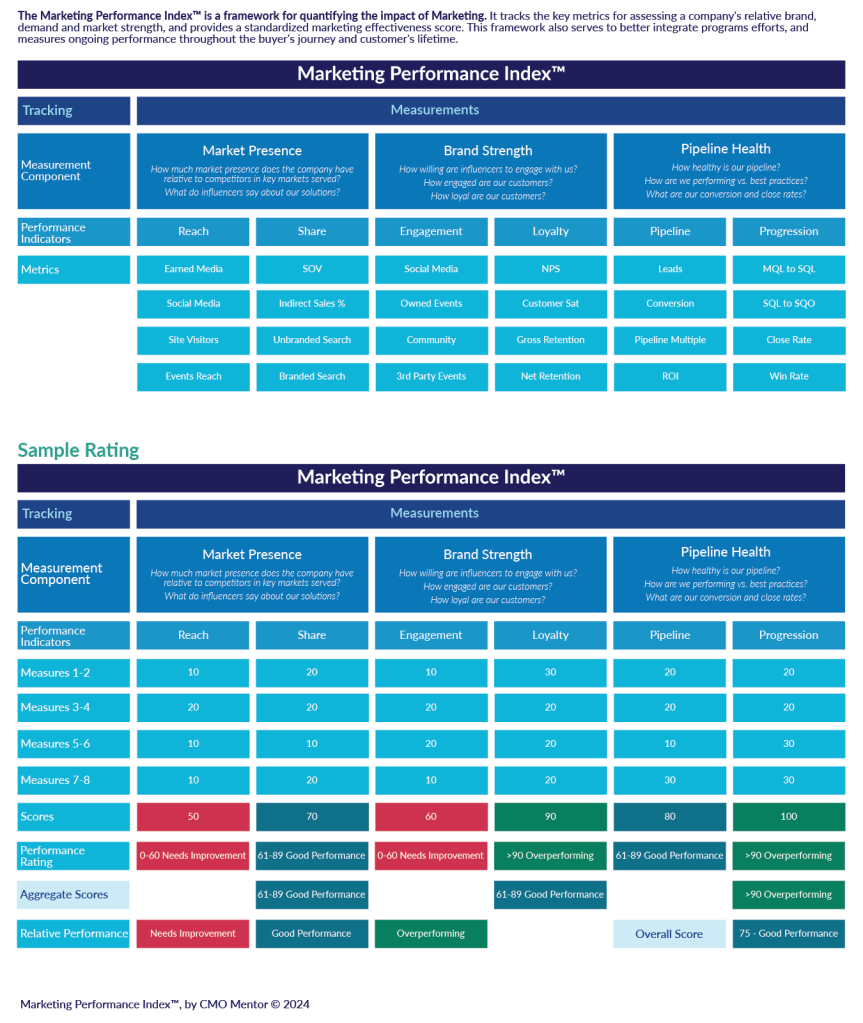
This dilemma demands a new approach to overcoming flawed expectations of what “CMO magicians” can do. We need a clear path to extricate the CMO from the perennial trap of ceaseless trying to prove the value of marketing. The Marketing Performance Index (TM) is an objective framework for quantifying the impact of Marketing in an objective, metrics-based manner. It tracks the key metrics for assessing a company’s relative brand, demand and market strength, and provides a standardized marketing effectiveness score. This framework also serves to better integrate program efforts, helps connect brand to demand, and measures ongoing performance throughout the buyer’s journey and customer’s lifetime.
How did we get here, when much of what marketer’s do is objectively measurable? It’s largely because, apart from pipeline creation, nearly the rest of the marketing function is often judged in a very subjective, and sometimes random manner (see Drew Neisser’s post “Everybody is a Marketer”). If you think about the typical marketing sub-functions besides demand generation, such as product marketing, brand marketing, partner marketing, marketing communications, marketing operations, Web marketing, etc., most, if not all, of these specialties are largely misunderstood. Non-marketers simply don’t understand what good looks like in these areas, can’t distinguish between best practices and poor ones, and thus apply a subjective lens to anything they can’t comprehend or precisely quantify. It’s no wonder many marketers are always explaining, defending, and trying to prove value.
So let’s turn this dilemma on its head and quantify Marketing’s value in a clear and defensible manner. Let’s think about Marketing at a higher level as orchestrating three primary objectives that are critical to any business: 1) Getting customers, by creating a healthy pipeline, 2) Growing the market, by building market presence, and 3) Keeping and growing customers, by building brand strength and customer advocacy.
The Marketing Performance IndexTM (MPI) is based on 20 years of empirical data, extensive peer review and having created more than $20 billion in pipeline. The MPI is a standardized methodology that marketers can adapt to their unique market situation to measure and improve overall marketing performance, and do so in a way that your stakeholders can understand and will accept.
The graphic below summarizes the 24 key performance metrics, comprised of eight market presence, eight brand strength, and eight pipeline health metrics for tracking the areas that most influence company growth and success.
The index will be available soon as an online self-service diagnostic tool. If you’d like to check it out in the meantime, please contact me at grant@cmomentor.com. By participating, you will receive your confidential score as well as how it compares to the anonymized, aggregated data, which is being updated on a continual basis.
Of course, this is not as simple as inputting your current baseline metrics and reporting your results (improvements) and voila, you are set! You will need to work with the CEO and other key stakeholders to gain agreement that these 24 metrics matter to your business, or substitute other metrics and performance targets. If you aren’t able to measure all of these variables, you can easily put a single variable in twice, or substitute other variables. You can also apply weighting factors to all six categories and/or the three major areas: market presence, brand strength, and pipeline health.
If you can get agreement, your odds of achieving and sustaining CMO success will certainly increase. I’m going to be doing a weekly blog explaining these variables in detail, why I selected them, what good looks, and what tactics can generally improve performance in each of the 24 metrics. Let’s work together to bring marketing the increased recognition our collective efforts deserve. Are you in? #marketing-is-provable #measurewhatmatters
 CMO Mentor