Strategy #3: Build Brand
Seven Key Elements
Having created and shaped several successful brands during the past 20 years, including FrontBridge (acquired by Microsoft), FileNet (acquired by IBM), Pegasystems, Kofax (acquired 4 times), Emburse, and now Billtrust, there are several keys elements that must be addressed to successfully build and maintain a global brand: charter; structure or architecture; investment; management; alignment; and advocacy.
Brand charter is the first, and in many cases, the foremost challenge. Brand charter means having both explicit and implicit empowerment to be the chief brand steward for the company, to be the arbitrator that breaks all ties related to key branding decisions, and to be the final authority. Branding, just like traditional and digital advertising and other forms of marketing communication, can be very subjective where everyone has an opinion, so it’s critical to establish early on that marketing has the vision, the expertise and the mandate to drive brand building and brand management decisions companywide and globally. When you have the right charter in place, it’s possible to make the tough calls without a committee, to drive consistency and to foster continuous improvement. Without a strong charter, the brand will never flourish and will struggle to maintain competitive positioning.
Brand structure is about having a brand architecture firmly in place. If the company is unsure whether to adopt a branded-house strategy (e.g., IBM), a house of brands (e.g., P&G), or an endorsed approach (e.g., Microsoft), building a brand will prove very daunting. Architecture is a useful metaphor for a branded house because it requires some level of hierarchy to define the relationship between the primary brand and all the sub brands and/or product lines and services brought to the market and supported by the primary brand. One key structural consideration is to not create too many levels in brand architecture. Most people have difficulty keeping more than two or three levels in their heads, so it’s best to manage toward a more streamlined brand structure.
When I was at FileNet, our brand structure was in disarray, with five levels of brand architecture creating confusing and overlapping messages to the marketplace. In addition to product brands (e.g., FileNet Content Manager), the company was branding specific features, technologies (e.g., Content Federation Services), and even the graphical user interface, or GUI (FileNet Workplace).
After careful examination, we streamlined our brand architecture to just two levels (FileNet + Product Brand Name) and relegated all other competing brand names to a more descriptive level to better support and maintain a coherent brand architecture. This process resulted in better informed sales and channel personnel and, most importantly, increased customer understanding of what we offered to the marketplace.
As part of the brand assessment process undertaken to develop the Pegasystems brand, the team examined competitive architectures. These architectures were, in many respects, quite similar to what I inherited when I joined FileNet (acquired by IBM), often consisting of five or more distinct levels of brand architecture.
At Billtrust, we have also simplified our brand architecture to focus on building the company brand, Billtrust. All product and service offerings are subordinated to the primary brand, as shown below.
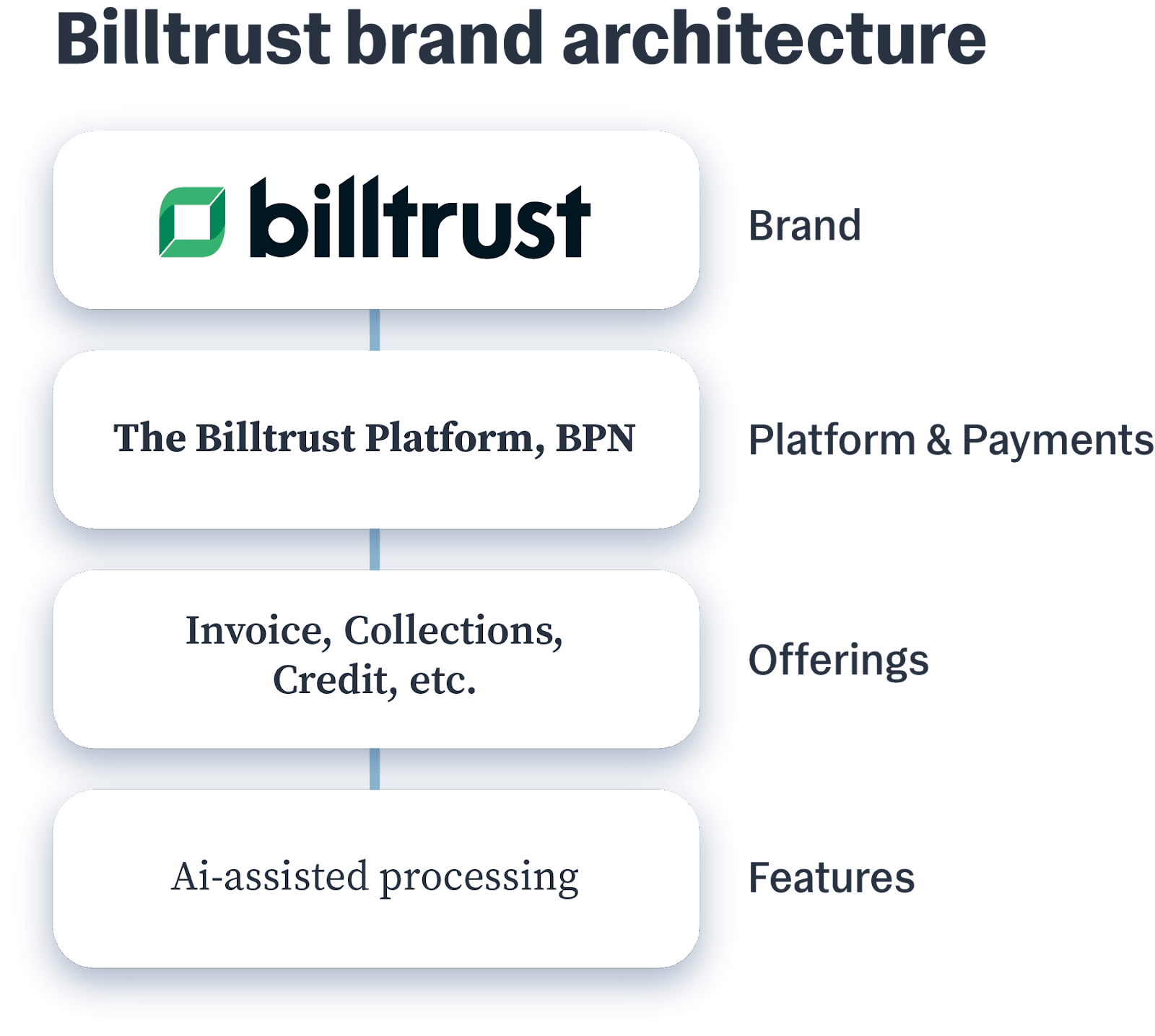
Figure 1. Billtrust Brand Hierarchy
Another key element is brand investment, and this aspect is typically centered on the brand building and investment philosophy the company or firm has in place. Is brand building considered a strategic imperative, a competitive differentiator, or merely an outcome of marketing communications? If it’s the latter, it will be difficult to get much attention or support around initiatives that require funding. As in life, companies, like people, invest in the things that are important to them, and having a brand development line item that is not solely for demand generation is the best way to ensure that brand building can be a strategic rather than a tactical consideration. During all five of my CMO tenures, I’ve been fortunate to have an executive team and Board of Directors support the need to invest in brand development on an ongoing basis.
The next key branding challenge is about having a clearly articulated brand management system and process in place to manage the brand. There are almost as many unique approaches to managing brands as there are brands. Best practices in every industry, however, whether B2B or B2C, dictate that a systematic approach to brand management can dramatically increase the speed and efficacy of brand building. Brand management is a discipline, just like accounting or architecture, so having a well-defined approach can greatly accelerate the path to successful brand management.
One such approach is called the framework for PowerBranding™. In the book PowerBranding™, which I co-authored, the framework (see figure 2) articulates four key elements or layers that must be addressed to systematically and effectively manage a brand or collection of brands. The first layer is brand foundation and it consists of having a well-defined brand mission, vision, values and a sustained financial commitment. The second layer is brand strategy, and it consists of articulating the differentiating positioning, personality and experience that brand represents and having an integrated strategy across all customer touch points to ensure maximum brand impact. The third layer represents the actual brand management practices including the system, structure, process and measurement of brand status and progress against stated brand objectives. The fourth and final layer is brand implementation, including the target markets and customers, marketing mix, programs and communication tactics designed to reach and influence customers and prospects.
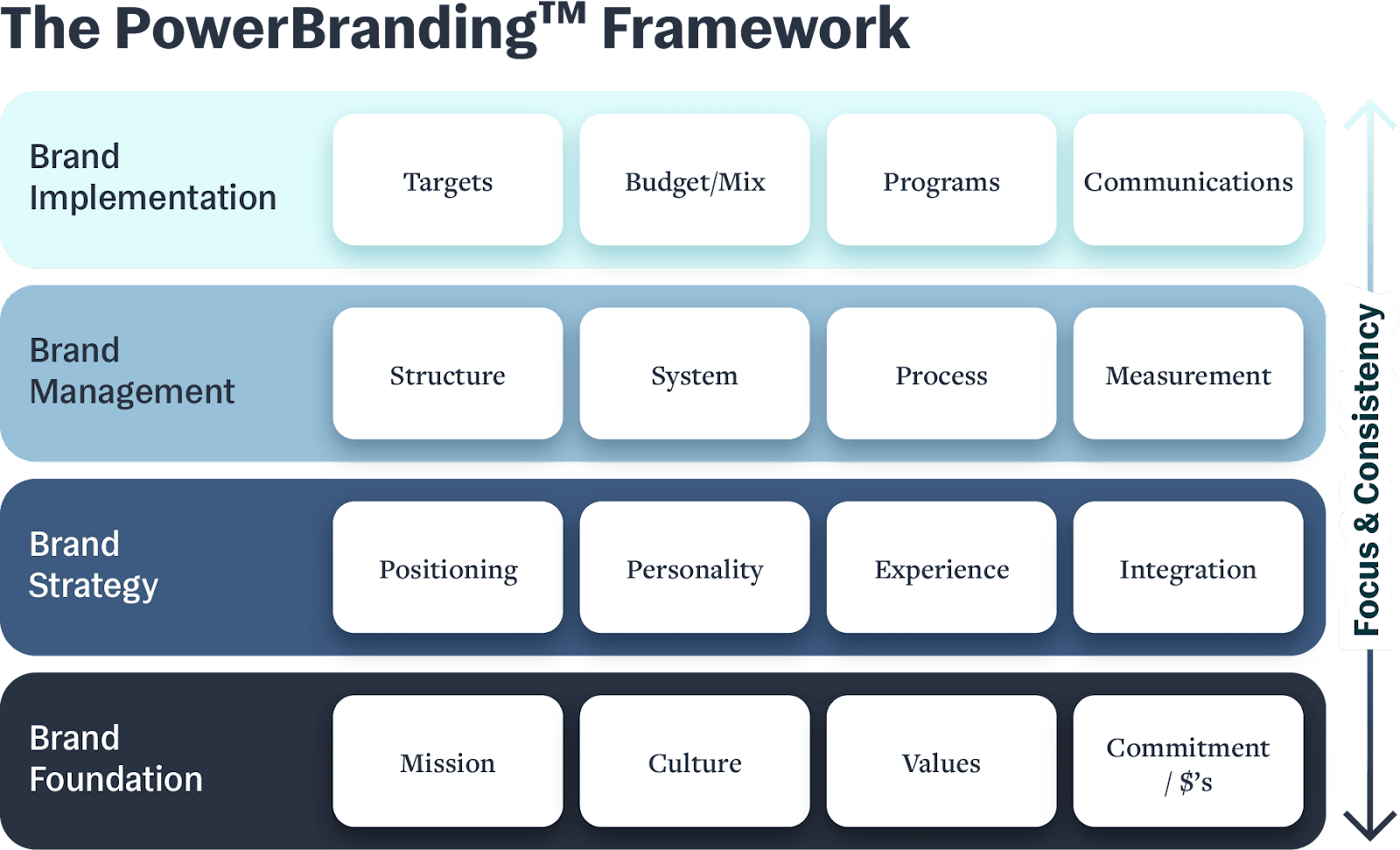
Figure 2. PowerBranding™ Framework
In addition to a brand system, many companies create comprehensive brand management guidelines that define everything from brand architecture and naming conventions, to acceptable brand or visual expression, collateral and editorial guidelines and more. Adopting and promulgating a comprehensive brand handbook or guide is an effective way to drive global consistency, especially if the brand guide clearly articulates all the dos and don’ts of proper brand usage. The more countries and languages in which a company markets their products and services, the more prone to local interpretation – or misinterpretation – brand usage can be, so having the guide translated, as appropriate, is also helpful. Ultimately, proper brand management requires some level of ongoing brand audits for compliance and a designated enforcement resource to ensure brand standards are adhered to and implemented in a proper and consistent manner.
Brand purpose means having a mission or promise that defines the brand and its reason for being. At Emburse, the company landed on the phrase “humanize work.” I helped launch the global brand for Emburse in January 2020, just before the pandemic. Over the next few years, as COVID-19 disrupted the work environment, dictating hybrid work environments and necessitating increased team collaboration, especially given the new more remote (e.g., work from home) nature of work, the relevance of the phrase “humanize work,” and how the company was delivering on the promise, increased. We did a lot of internal, as well as external promotion, to give meaning to the phrase and ensure the technology, work processes, and most importantly, the company’s staff, delivered on the promise. In fact, in concert with the new brand rollout, the exec team decided to renew its values and, as one of the principal leaders for this refresh, I help us pick values that were contained in a simple pneumonic: SEE IT, representing the 5 core values of Sincerity, Empathy, Empowerment, Individuality and Teamwork.
Next, brand advocacy is perhaps the most important element. The larger an organization, the harder it is for the CMO to be everywhere and touch everything related to building, let alone maintaining, a global brand. At Pega, the company created a simple brand personality acronym to help every employee get involved in brand building. The four brand attributes were Passionate, Engaging, Genuine and Adaptive, and the company created a video compilation entitled, “How PEGA are you?” in which employees from the US, European and Asia-Pacific regions talk about how they embody the four key personality traits.
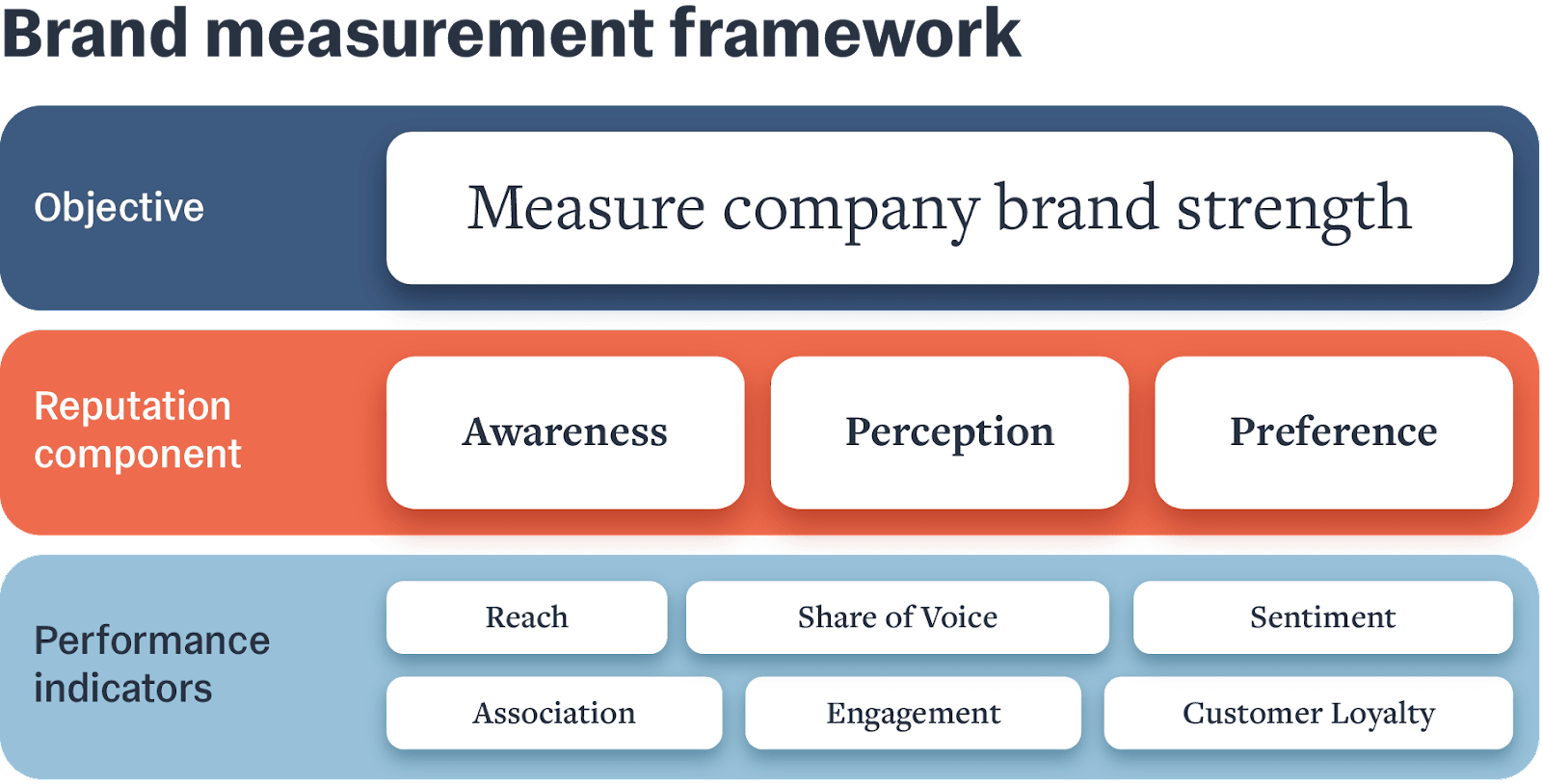
And finally, there is brand measurement, because, after all, everything a company does to proactively manage its brand should increase brand value over time. There are many ways to measure brand value, from low-cost brand proxy measures, like share of voice (SOV), brand sentiment and web traffic, to more sophisticated and costly brand tracking and research methodologies. My team and I came up with a very simple, yet comprehensive framework, with help from Forrester Research. Shown below, the framework tracks unique measures for brand awareness, perception, and preference across 6 discrete representational elements: reach, SOV, sentiment, association, engagement and loyalty.
 CMO Mentor